Monday, 15 September 2014

Scots pine starters - 2 years later


This is the end of the second year of growing these Scots pines from seedlings. They are a bit different to grow than other broad leaved species in that they seem a lot slower - taking a long time to grow roots and stabilise themselves in the pots. This is nice in that you can take your time to arrange the surface roots - unlike Oaks which would have massive tap roots circling the pot in 2 years.

These are the 2 prime pines - now planted over into the new air-pots. There is a 3rd one which is ok and will be used to experiment on other soil types and a 4th which will be a planted out in a quiet flower bed to retire.

I wire a big bend into the trunks to make them a bit more interesting - no s-bends just a single curve. This takes about 4 months to set - and by the end of the year the wire marks are not visible any more. The large one was too stiff to bend by the time I got around to it.

All of these pines that I am currently growing have a good selection of lower growth. I have removed the tightly clustered lower growth to avoid major trafic nodes and have a nice spread of shoots to choose from when i sacrifice the upper sections.

The largest is now 22mm thick and the rest are about 18mm. I believe that a good root colonisation is responsible for the enhanced growth of the big one. The fungi seem to prefer the clay pebbles to the coco media - so i may plant the last good pine in pebbles and see what it does.
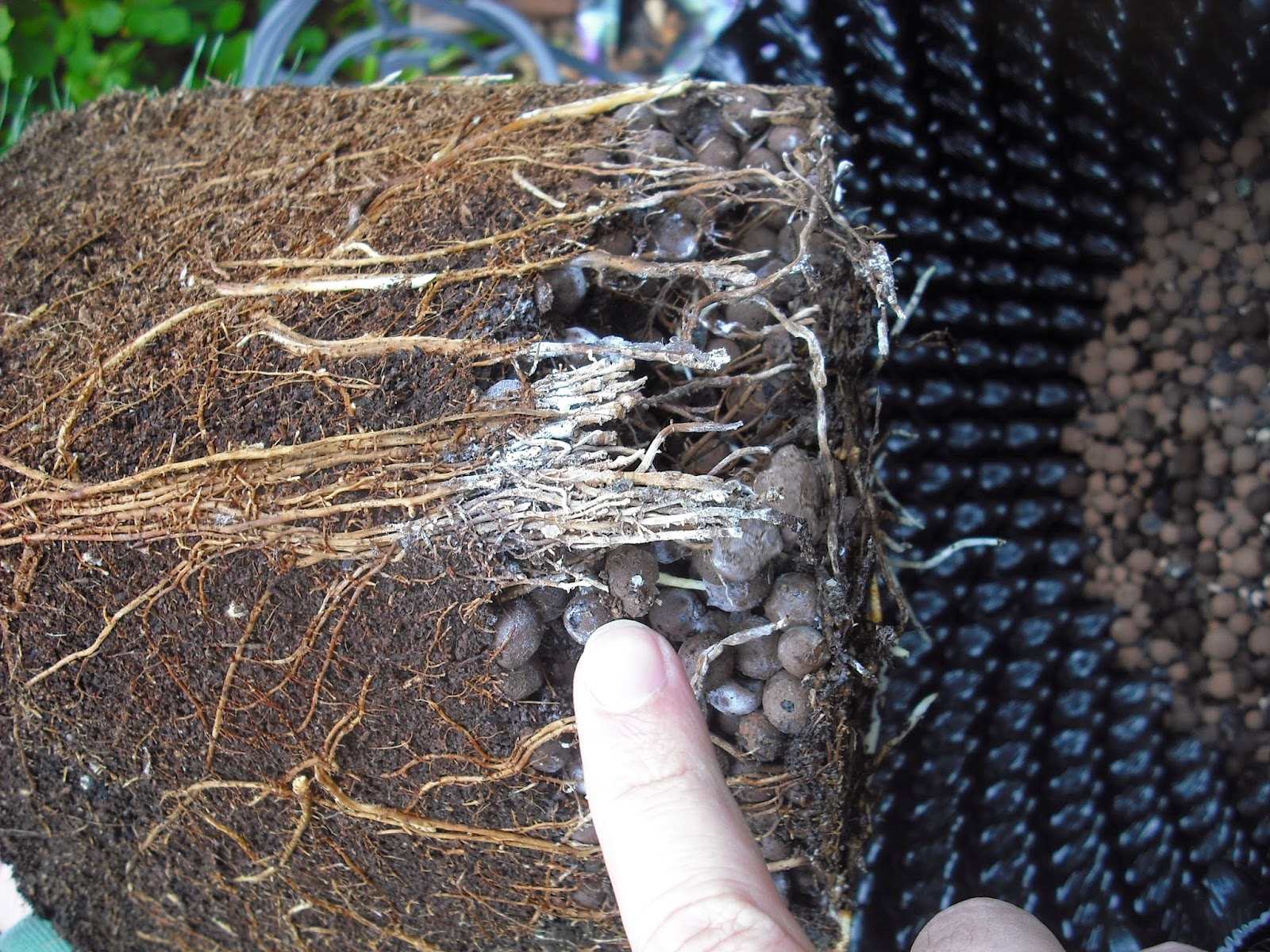


The more vigorous one has quite a good colonisation of the roots by Mycorrhizal which probably explains why it's so much bigger than the other. I preserved all of the roots which were visibly colonised.

I was planning to move them over to colanders but discovered these air-pots which seem to be the ideal solution to the problem. I had thought that I was a genius for discovering them and using them with pines - but I know that several others have beaten me to it.


Here the same 2 pines are last year at about this time of year.

I potted them now in the late summer once the growing was over but the roots still active. They should settle in nicely over the next few months and then have a big start to the spring.

Here are the roots after 2 years in coco. Even at this stage it's still not too root bound - although this is probably the right time to move them up to a better pot. I didn't want to disturb the roots too much at this time of the year so I moved them over like this. The air-pot should clear up the few wrap around roots in there.


So after 2 years of trying the canna soils the coco coir media of the professional plus is the way to go for me.

These are planted again into the coco growing media with clay pebbles lining the bottom of the pots.


Wednesday, 27 August 2014

Big pot Oak - another year


Since April 2003 I have been growing this Oak in a large pot. It's been a tough growing summer in sunny southern England. It's late summer for my large Oak and it's looking a bit untidy from all the mildew burns on the leaves. Even with careful watering I still had a lot of leaf burn on many other species - just cooked because it was too hot - no problems with nutrients or salts. About the only thing that doesn't seem to burn is the Oak. Due to the shortage of rainwater during the peak of the summer it got a lot of London tap water and this doesn't seem to have made any difference either.

This one has increased greatly in ramification this year. I've been using guy wires to keep the branches heading in more or less the right direction. I continue to shorten all the top growth and allow the lower branches to grow freely. The taper is quite nice now - and the thick side branches are enhancing the movement in the trunk.


Using the same matchbox again 12 months later you can see that the base of the trunk has expanded significantly - its approx 6cm now. And its a bit exciting to see that there may be some bark forming at the base too.

I imagine that I see some good radial surface roots forming around trunk as well.

I went to great expense (£3.95 ) and bought a soil pH checker. When I first checked the Oaks pot the pH was close to 4 - which can't be good even if the plant likes acidic conditions. I got some lime which is useful for increasing the pH and also adds calcium and magnesium to the soil. The soil is now a much friendlier 6.5 and I know that all the important macro-nutrients are in plentiful supply.


I'm find that every time I walk past it now I want to transfer it to a bonsai pot and start working on the twigs. I also know that I need to keep its roots under control and the longer it stays in this pot the more difficult it will be. Over the last 18 months it has increased in trunk diameter from 3cm to 6cm and its is tempting to let it expand another year and risk the root problems.

Its been interesting to learn that there are other bonsai growers out there going through this same process with Oaks. I hope to get to see how they have been going with their attempts.


Sunday, 10 August 2014

Milk as a fungicide


A week ago I sprayed my Oak trees with a dilute solution ( about 1 : 8 ) of skim milk to try to treat the very heavy powdery mildew which had infected them all. It was killing off all the new growth coming through in the late summer.


After waiting a week to see what happened I had a look at my Oak leaves which were sprayed as an attempt to treat the heavy powdery mildew. I am so extremely surprised at how effective this has been. The underlying damage to the leaves is obviously still there - but the mildew is almost entirely gone.


This should extend my growing season a little and improve the vigour of the oaks greatly. 

This is a great treatment. I cant see any downsides.