Showing posts with label beech. Show all posts

Thursday, 28 January 2021

Beech progress


The tree is still a bit skinny. I placed it in a larger pot hoping for some more trunk growth.
January 2021.


Some years earlier - about 8 I think. Not happy with the progress.


 January 2013 in fact. 


Sunday, 27 July 2014

Mid season leaf problems

I have been growing various things (including bonsai) using Canna coco coir as a growing medium. It's nice in that over a year it doesn't change in volume. It seems to stay nice and airy around the roots too. The only problem with coco is that it can cause a shortage of calcium - hence the special coco orientated fertilisers. I didn't understand until I did some more research.

http://en.wikipedia.org/wiki/Coir


I started to see leaf curl on my habanero chilli plants - so I did some research. I bought some calcium nitrate fertiliser off Amazon. I added this to my organic fertiliser and I haven't had a curled leaf since. The vitality of the chilli plants has increased as well.

Now I am growing some Scots pines in this same growth medium so maybe they have the same nutrient issues? I gave them a dose and they seem to be a bit more perky.

I now understand why their nutrients come in 2 parts - the calcium and potassium form insoluble precipitants in the solution if they are too concentrated. So I know they are looking after the calcium issue. I am using the soft water version of the fertilisers - so I should be OK. But something still seems to be wrong.

The calcium nitrate has fixed my citrus up nicely - and my cherry no longer has lacy leaves on its second flush. I have a Pyrus pyraster (wild pear) which is also giving much better growth with this treatment. So far, so good.


In the summer when it's warm I use organic fertilisers and rainwater. This may be negating the effect of the specialised nutrients looking after the calcium issues with coco growing mediums.


My copper beechs have a lot of burning on the leaf edges. I'm unsure if it's salt or the hot weather? I am fairly certain that this isn't the calcium issue affected the fruiting/flowering trees in coco coir soils. These are in my experimental very large pots. I water these with tap water because I just don't have enough rain water to go around. The beechs in clay based substrate are much better off - but they tend to get the rain water by hand and not the garden hose.

I tested the pH in my rainwater butts and it was off the scale of my test kit - so well less than a pH of 6. I have bought some hydroponic pH stuff to take this up a little as it can affect the beech roots. I will also test the soil acidity to understand this problem better. I will aim for a pH of 6.0 - 6.5 as this gets rid of the aluminium toxicity problems.

This is really annoying as June/July are the months when the beech will give its peak growth.

In addition my poor oaks have terrible powdery mildew - it's really ruining second flush this summer. I have sprayed this with milk (diluted 1-10) and will report back on the success of this treatment method. I have ordered some systemic fungicide just in case - but I prefer the milk spray if it works.


I am wondering if my low fat milk works as well as full fat ?

Saturday, 28 December 2013

Winter repotting observations


This is my first beech. It is pioneering the techniques that I will use on the other bigger ones in years to come.

http://englishbonsai.blogspot.co.uk/2012/04/first-copper-beech.html

In 2012 it was the smallest and least interesting beech - and now it is almost the largest and very interesting - at ground level the trunk is now 5-6 cm diameter. There is a good taper in the trunk and some gentle movement. I have never seen a wild beech tree that looked like a deep fried pigs tail - so the gentle movement is just right.

The difference in growth rate and quality of foliage may be partly due that the big pots being on tap water and cheap bulk fertilser whereas this one has been on rainwater and Canna Bio Vega.

Santa brought me some nice sundries - more soil stuff and some training pots - so that the trees that were in training could be re-potted into bigger and better pots.


This picture as I pulled it out of the pot today (28 Dec) seems to show that the root system is quite busy underground in mid winter. Well it has been a very mild winter so far but I'm still surprised.

This soil mix has worked very well and the tree has really done very well in it. In retrospect adding the bark to the otherwise inorganic growing medium was a good idea.

Beech trees in their native forest habitat are dependant on mycorrhizal fungus for their nutrition. Their metabolism seems to be set up that way - so I am doing it in miniature in pots. This beech has had several flushes of growth this year and needed a lot of cutting back - especially the apex - the other beech trees just give me a single flush.


This is the growth medium I am using this time. 3 parts of biosorb + 3 parts supalite + 2 parts bark - none of which were filtered or graded. The biosorb particles are a bit coarse so the smaller supalite particles bring down the average. As you can see in a later image the roots have done very well in this fine average particle size medium.

And the pink soil is ugly. In retrospect the bark addition is the important bit as it gives the natural fungi something organic to cling to. And as I have been exclusively using organic fertilisers for the last few years it is vital to have all the soil micro organisms present to get the nutrition to the plant.


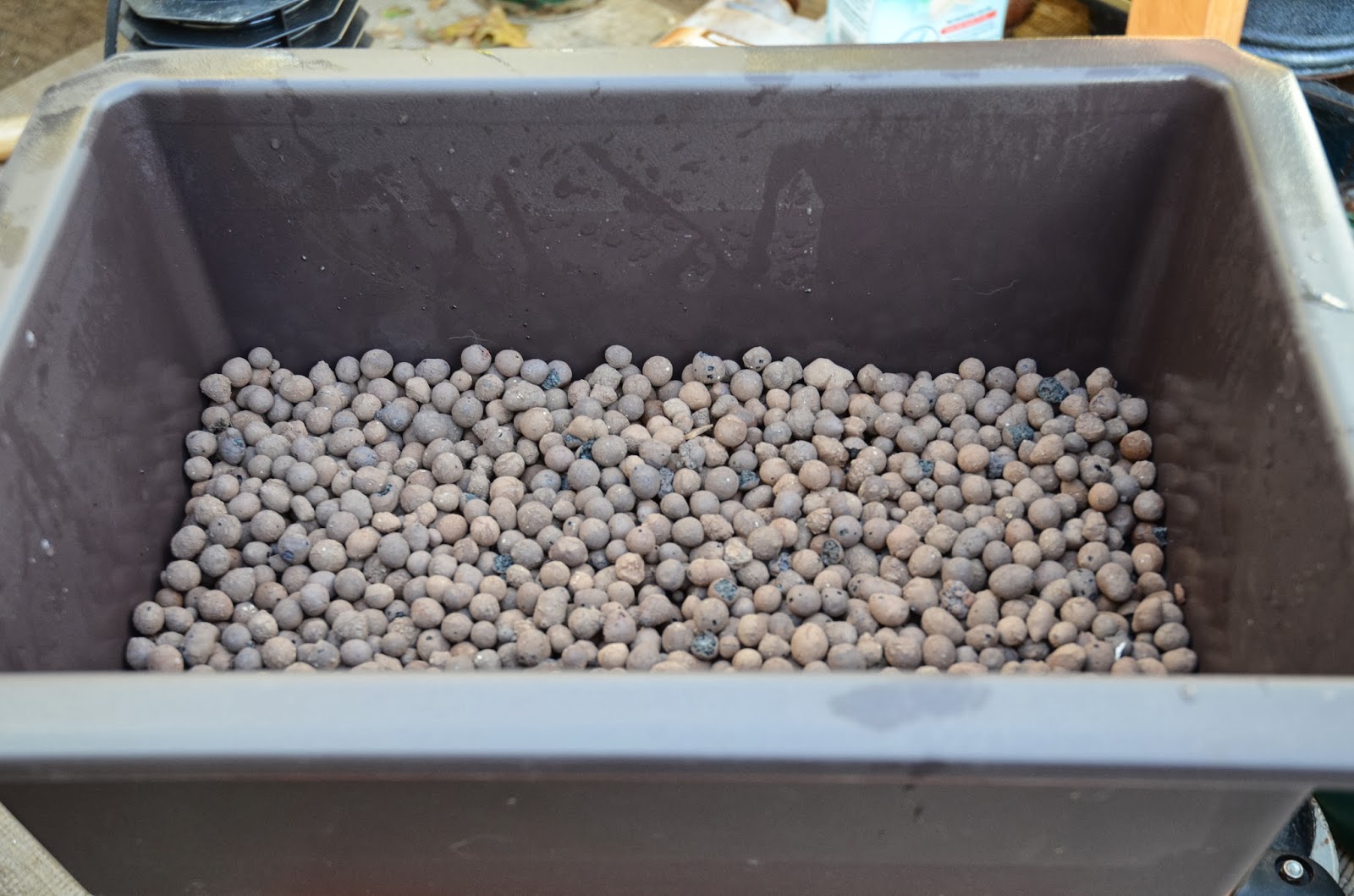
I am lining all my pots with these coarse clay pebbles as a drainage layer. These big plastic training pots are 32x45x16 cm. I fill them to within about 1 inch of the top to make them nice and easy to water.


I was very happy when I saw these roots. Lots of fine roots. All I did was work the edges of the pot loose and trim some thick roots out. There wasn't much to do as I had a pot full of lovely fine roots.


Here it is back out on the bench. It's going to spend another 2 years in that pot.

While I was out there I decided to re-pot another of the trees. It's a field maple that I collected several years ago. I had been ignoring it as they seem to have a strange growth habit - and I was trying to understand it - there were odd bursts of growth and then long periods of dormancy. It was potted in pure biosorb.


It was in an old ceramic pot that was slowly disintegrating in the winters here. The most important thing here is what is living in the bottom of the pot. It is teaming with fungus gnat larvae - alive and wriggling in mid winter and weakening the tree for the spring. I am certain that this is the reason for the odd growth habit - it was under constant attack from pests in the soil. It also wanted more food - and it had quite a good year because I put it on the same feeding rotation as the big pine trees.


This is the field maple with all the thick roots removed and trimmed back to the coarse drainage layer. Nothing to complain about here. I'm hoping that next year I will do a lot better as the feeding will be right and the pests will be removed.


Not a great image - and it's over potted - but I'm hoping for 3 years in that pot and then a decision on its future. It will be pest free and very well fed. I'm thinking that the trunk will at least double in diameter over that time. As I hadn't cut it back much its branch structure is full of strange tapers and odd shapes.

The important observations from this session of re-potting are.

Natives grow very well in a finer particle inorganic mix.
Adding an organic particle to the substrate is important - especially with organic fertilisers.
Pest prevention in the pot is essential - fungus gnats are a real problem and difficult to cure.
Trees in a sterile substrate need a surprising amount of feeding to thrive.
Trees in training must be groomed constantly.


Saturday, 7 December 2013

Big pot growing experiment

In early April I planted a few trees into giant pots, as an alternative to field growing as I don't have my own garden to dig up and experiment in. This is the result after the first year. 


I have been putting wire around the trunks as a Dendrometer so that I could have a good idea of the growth. Next year when they are settled I will be more scientific in my observations and keep more regular measurements.

It seems that the strong growth of wood begins in early April and ends in early September - before and after that there is still a lot of vegetative growth. This is outdoors and will be different under glass - early budding maples in cold shelters will have their major expansion earlier in the year.

Next year I will be sure to regularly water and fertilise during this critical period of growth (March to May). On established bonsai this is the time to go easy on the feeding to avoid big leaves and fat shoots.

This is an early August picture of the base of the oak tree. There is some good expansion already.


It already has a nice taper and a little movement in the trunk so it's not like a lamp post. I don't see many oaks with much movement in the trunk growing in the fields around home so I see no point in an oak bonsai that looks likes a pig's tail.

This picture was taken in early December after the leaves had dropped. I used a match box for scale (which is 5.5cm wide). There seems to have been another bit of growth since the previous picture. This is no surprise as it had been very active above ground.


The beech expansion was less impressive but still good. Its already quite a lot bigger than the oak - I think its a year older.


The beech does seem to want a little time to settle into its new home before it really gets going so I hope for a strong showing next year. My previously repotted beech trees have shown a pattern of growing a lot better in their second year. I suspect that this is due to the fact that the beech root system begins its growing after the budding - so potentially the new growth is a bit starved in its first year.

Given the behaviour of the root systems it is my opinion the trees must be potted and settled by mid March.

On both of these trees (especially the oak) I have been constantly pruning to keep their apical dominance at bay. I am specifically encouraging the lower side branches on both.

So far it all seems to be working.

Tuesday, 16 July 2013

Summer Lammas growth

Ive been enjoying a few more days away from work - a well timed gap between projects as I am able to water more often during this spell of hot weather we are having. The weather seems to have kicked off an unusual spurt of growth in some species - specifically the Beeches and Oaks.

I have written before about the Lammas growth - but this year it is very pronounced. I’m guessing that the nice weather has helped the trees to achieved their energy targets for the next winter and they have surplus so they spend it on new growth.

These Lammas leaves in the second flush seem to have come out very quickly and aren’t as nicely formed as the spring leaves. The Beech leaves are a strange colour and the Oak leaves can be slightly deformed having fewer lobes and unusual veins in the leaves.

http://en.wikipedia.org/wiki/Lammas_growth


My small first generation Beech which I potted for fun is coming along really nicely. It is by far the most vigorous of the current generation of Beeches I have. Almost every branch tip is giving growth. I’m nibbling away at the apex buds to keep its apical dominance at bay. These seems to be leading to the lower branches getting some growth as well.


On larger pot grown beeches I’ve nibbled back everything on the crowns to keep them in check. They will grow very thick branches up top if allowed - which leads to an ugly knob forming and no taper. The plan is to allow unrestricted growth on the side branches - especially the lower ones - to allow a good taper for form. Wild Beeches don’t have a great deal of taper but it will look nice - and nice even side branches are easy on the eyes.


In theory I am interrupting the apical mechanism by nibbling off these apex shoots which generate the Auxins hormone which is inhibiting the lower buds from growing - which should give me good sideways growth.


The Oaks are also doing the Lamas thing. I’ve allowed one of the Oaks to grow unchecked and its growing at a massive rate - this one is due for some strategic pruning soon. For taper I am also trying to keep the top end of the oaks in check and get the side branches working.

This Oak wanted nothing to do with hormones and simultaneously elongated everything.
 

These are my first generation of field / large container grown trees. They contain many mistakes and I see them purely as a learning exercise. Useful for acquiring technique - something large and cheap to try stuff out on. I don't expect and good bonsai material out of these - although the little beach is looking nice. 

I planted what I would call second generation trees at the beginning of this year. I’ve allowed them to establish roots and will do some early wiring to the trunks to get something interesting happening there - none of that hyper contorted leaping dragon nonsense - just a bit of interest.


As usual the cat has been overseeing matters.  


Sunday, 22 April 2012

First Copper Beech


I decided to start working on one of the hedgerow beech trees that i bought 2 years ago - as the beech buds were all swelling up nicely. There were bought bare root - so i am certain that the roots can be taken back a long way. This image is after 2 years in some nice soil - living out on the lawn with regular water and fertiliser. I was a little surprised at the generous amount of root that had developed. It was pot bound after 2 years. 

This one is the least interesting of the trunks so i decided to use it first as a learning experience for working with beech trees. From most angles its about 2" thick somewhat above the ground level.


I removed all the long circling roots and blasted out most of the old soil with water. There were a few problematic thick roots which i cut back a little. That root to the left was just too far up to be kept and was later removed.


The soil mix used to grow this was quite good and i think i will use something close to it again in the future. Lots of coarse sand and horticultural grit - with plenty of perlite. The 3 beech trees grew on very well in this and created fantastic root systems full of fine feeder roots - hence the good growth rate of the trunks.


I created a soil mix based a bit on the work from the last few years. Pure biosorb was a bit hard to grow in. It required a lot of fertiliser and water. It is still primarily biosorb - but i have added finely graded fuji grit and akadama. There is also a heavy helping of pine bark in there. The soil mix is generously inoculated with rootgrow. I will begin fertilizing very soon with fish emulsion ( gave it a good drenching today ).


This beech will be kept under glass until it is in rude health.