
This is my first beech. It is pioneering the techniques that I will use on the other bigger ones in years to come.
http://englishbonsai.blogspot.co.uk/2012/04/first-copper-beech.html
In 2012 it was the smallest and least interesting beech - and now it is almost the largest and very interesting - at ground level the trunk is now 5-6 cm diameter. There is a good taper in the trunk and some gentle movement. I have never seen a wild beech tree that looked like a deep fried pigs tail - so the gentle movement is just right.
The difference in growth rate and quality of foliage may be partly due that the big pots being on tap water and cheap bulk fertilser whereas this one has been on rainwater and Canna Bio Vega.
Santa brought me some nice sundries - more soil stuff and some training pots - so that the trees that were in training could be re-potted into bigger and better pots.

This picture as I pulled it out of the pot today (28 Dec) seems to show that the root system is quite busy underground in mid winter. Well it has been a very mild winter so far but I'm still surprised.
This soil mix has worked very well and the tree has really done very well in it. In retrospect adding the bark to the otherwise inorganic growing medium was a good idea.
Beech trees in their native forest habitat are dependant on mycorrhizal fungus for their nutrition. Their metabolism seems to be set up that way - so I am doing it in miniature in pots. This beech has had several flushes of growth this year and needed a lot of cutting back - especially the apex - the other beech trees just give me a single flush.

This is the growth medium I am using this time. 3 parts of biosorb + 3 parts supalite + 2 parts bark - none of which were filtered or graded. The biosorb particles are a bit coarse so the smaller supalite particles bring down the average. As you can see in a later image the roots have done very well in this fine average particle size medium.
And the pink soil is ugly. In retrospect the bark addition is the important bit as it gives the natural fungi something organic to cling to. And as I have been exclusively using organic fertilisers for the last few years it is vital to have all the soil micro organisms present to get the nutrition to the plant.
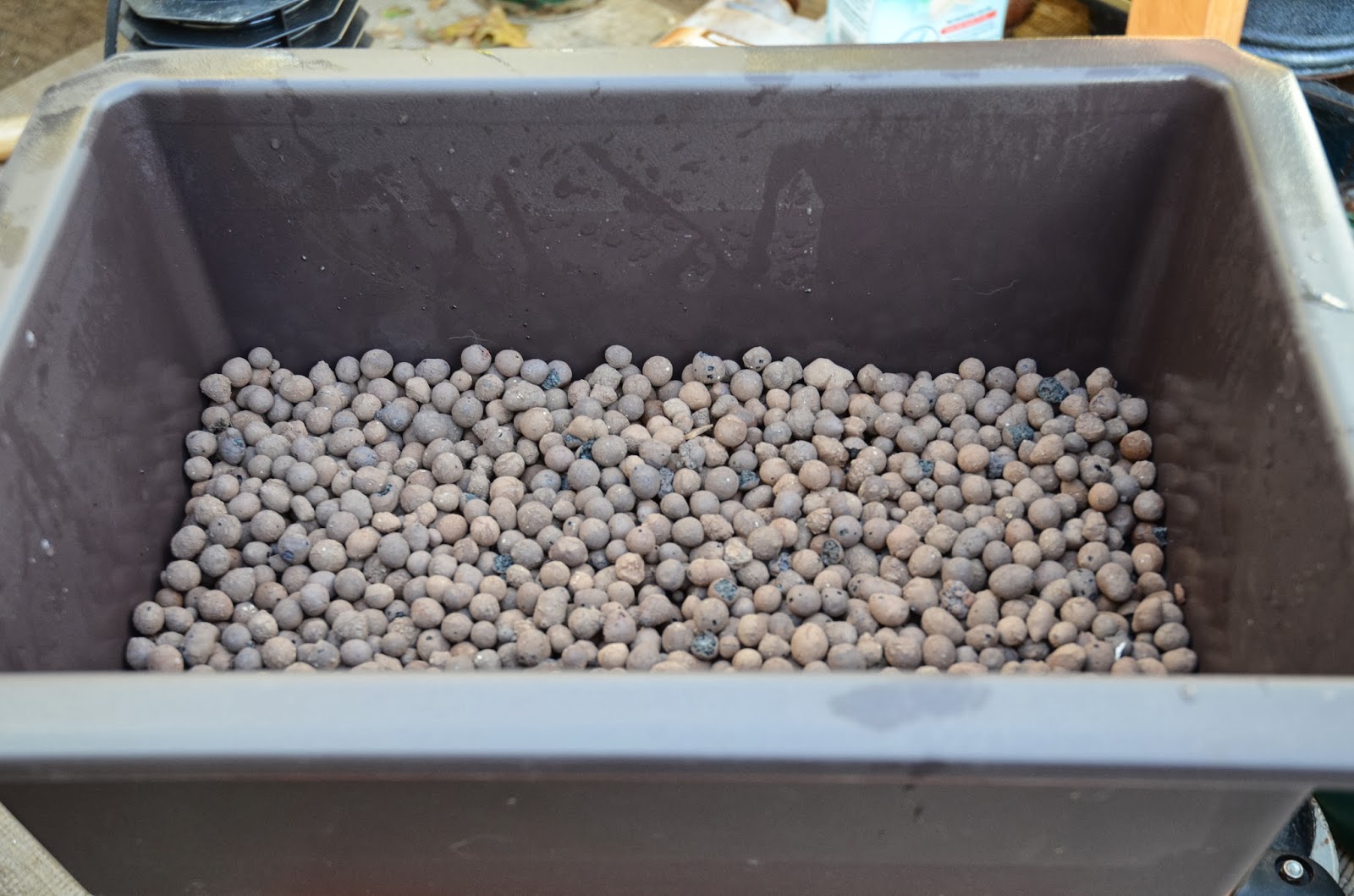
I am lining all my pots with these coarse clay pebbles as a drainage layer. These big plastic training pots are 32x45x16 cm. I fill them to within about 1 inch of the top to make them nice and easy to water.

I was very happy when I saw these roots. Lots of fine roots. All I did was work the edges of the pot loose and trim some thick roots out. There wasn't much to do as I had a pot full of lovely fine roots.

Here it is back out on the bench. It's going to spend another 2 years in that pot.
While I was out there I decided to re-pot another of the trees. It's a field maple that I collected several years ago. I had been ignoring it as they seem to have a strange growth habit - and I was trying to understand it - there were odd bursts of growth and then long periods of dormancy. It was potted in pure biosorb.

It was in an old ceramic pot that was slowly disintegrating in the winters here. The most important thing here is what is living in the bottom of the pot. It is teaming with fungus gnat larvae - alive and wriggling in mid winter and weakening the tree for the spring. I am certain that this is the reason for the odd growth habit - it was under constant attack from pests in the soil. It also wanted more food - and it had quite a good year because I put it on the same feeding rotation as the big pine trees.

This is the field maple with all the thick roots removed and trimmed back to the coarse drainage layer. Nothing to complain about here. I'm hoping that next year I will do a lot better as the feeding will be right and the pests will be removed.

Not a great image - and it's over potted - but I'm hoping for 3 years in that pot and then a decision on its future. It will be pest free and very well fed. I'm thinking that the trunk will at least double in diameter over that time. As I hadn't cut it back much its branch structure is full of strange tapers and odd shapes.
The important observations from this session of re-potting are.
Natives grow very well in a finer particle inorganic mix.
Adding an organic particle to the substrate is important - especially with organic fertilisers.
Pest prevention in the pot is essential - fungus gnats are a real problem and difficult to cure.
Trees in a sterile substrate need a surprising amount of feeding to thrive.
Trees in training must be groomed constantly.


