Saturday, 28 December 2013

Winter repotting observations


This is my first beech. It is pioneering the techniques that I will use on the other bigger ones in years to come.

http://englishbonsai.blogspot.co.uk/2012/04/first-copper-beech.html

In 2012 it was the smallest and least interesting beech - and now it is almost the largest and very interesting - at ground level the trunk is now 5-6 cm diameter. There is a good taper in the trunk and some gentle movement. I have never seen a wild beech tree that looked like a deep fried pigs tail - so the gentle movement is just right.

The difference in growth rate and quality of foliage may be partly due that the big pots being on tap water and cheap bulk fertilser whereas this one has been on rainwater and Canna Bio Vega.

Santa brought me some nice sundries - more soil stuff and some training pots - so that the trees that were in training could be re-potted into bigger and better pots.


This picture as I pulled it out of the pot today (28 Dec) seems to show that the root system is quite busy underground in mid winter. Well it has been a very mild winter so far but I'm still surprised.

This soil mix has worked very well and the tree has really done very well in it. In retrospect adding the bark to the otherwise inorganic growing medium was a good idea.

Beech trees in their native forest habitat are dependant on mycorrhizal fungus for their nutrition. Their metabolism seems to be set up that way - so I am doing it in miniature in pots. This beech has had several flushes of growth this year and needed a lot of cutting back - especially the apex - the other beech trees just give me a single flush.


This is the growth medium I am using this time. 3 parts of biosorb + 3 parts supalite + 2 parts bark - none of which were filtered or graded. The biosorb particles are a bit coarse so the smaller supalite particles bring down the average. As you can see in a later image the roots have done very well in this fine average particle size medium.

And the pink soil is ugly. In retrospect the bark addition is the important bit as it gives the natural fungi something organic to cling to. And as I have been exclusively using organic fertilisers for the last few years it is vital to have all the soil micro organisms present to get the nutrition to the plant.
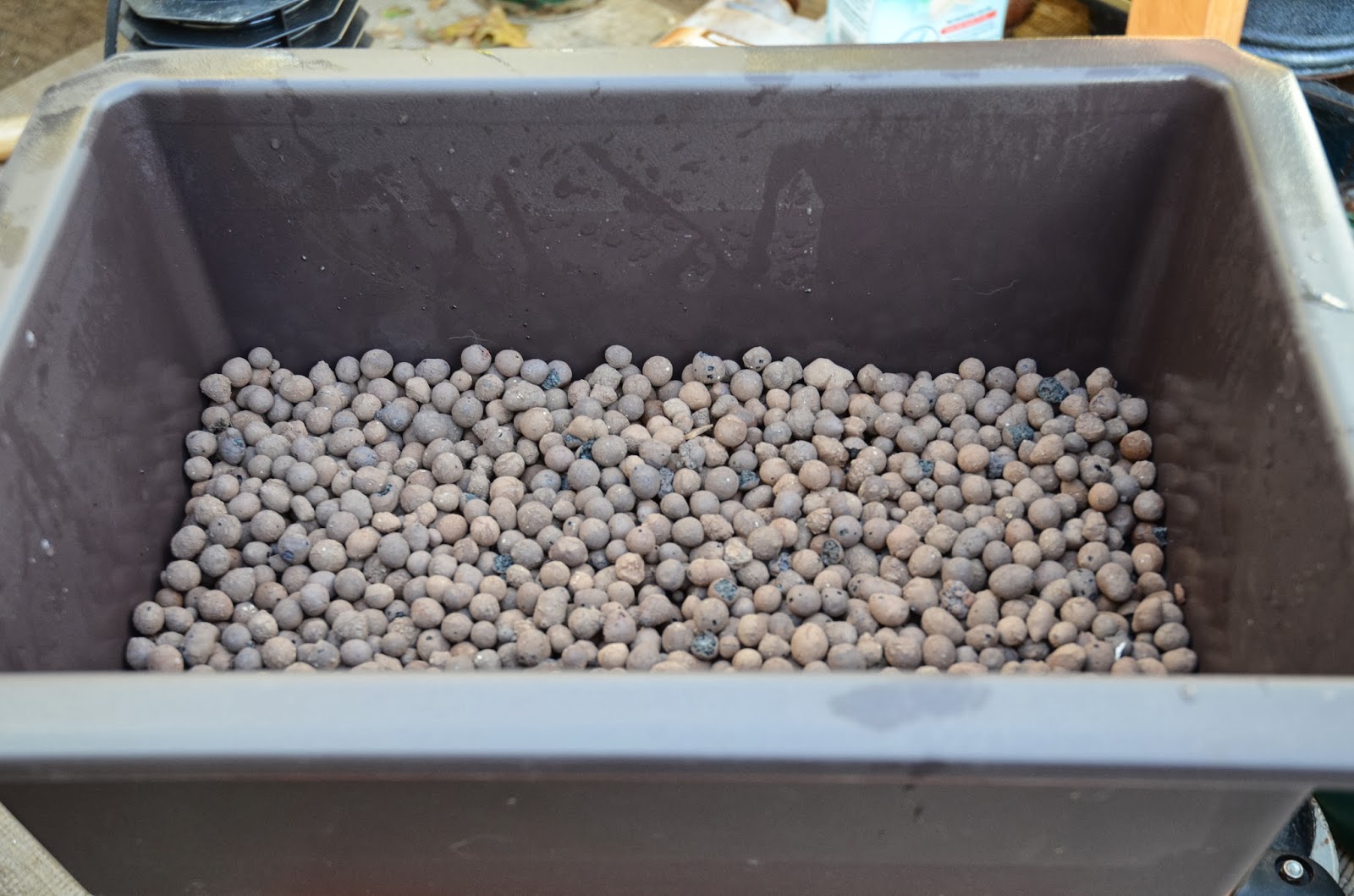

I am lining all my pots with these coarse clay pebbles as a drainage layer. These big plastic training pots are 32x45x16 cm. I fill them to within about 1 inch of the top to make them nice and easy to water.


I was very happy when I saw these roots. Lots of fine roots. All I did was work the edges of the pot loose and trim some thick roots out. There wasn't much to do as I had a pot full of lovely fine roots.


Here it is back out on the bench. It's going to spend another 2 years in that pot.

While I was out there I decided to re-pot another of the trees. It's a field maple that I collected several years ago. I had been ignoring it as they seem to have a strange growth habit - and I was trying to understand it - there were odd bursts of growth and then long periods of dormancy. It was potted in pure biosorb.


It was in an old ceramic pot that was slowly disintegrating in the winters here. The most important thing here is what is living in the bottom of the pot. It is teaming with fungus gnat larvae - alive and wriggling in mid winter and weakening the tree for the spring. I am certain that this is the reason for the odd growth habit - it was under constant attack from pests in the soil. It also wanted more food - and it had quite a good year because I put it on the same feeding rotation as the big pine trees.


This is the field maple with all the thick roots removed and trimmed back to the coarse drainage layer. Nothing to complain about here. I'm hoping that next year I will do a lot better as the feeding will be right and the pests will be removed.


Not a great image - and it's over potted - but I'm hoping for 3 years in that pot and then a decision on its future. It will be pest free and very well fed. I'm thinking that the trunk will at least double in diameter over that time. As I hadn't cut it back much its branch structure is full of strange tapers and odd shapes.

The important observations from this session of re-potting are.

Natives grow very well in a finer particle inorganic mix.
Adding an organic particle to the substrate is important - especially with organic fertilisers.
Pest prevention in the pot is essential - fungus gnats are a real problem and difficult to cure.
Trees in a sterile substrate need a surprising amount of feeding to thrive.
Trees in training must be groomed constantly.


Saturday, 7 December 2013

Big pot growing experiment

In early April I planted a few trees into giant pots, as an alternative to field growing as I don't have my own garden to dig up and experiment in. This is the result after the first year. 


I have been putting wire around the trunks as a Dendrometer so that I could have a good idea of the growth. Next year when they are settled I will be more scientific in my observations and keep more regular measurements.

It seems that the strong growth of wood begins in early April and ends in early September - before and after that there is still a lot of vegetative growth. This is outdoors and will be different under glass - early budding maples in cold shelters will have their major expansion earlier in the year.

Next year I will be sure to regularly water and fertilise during this critical period of growth (March to May). On established bonsai this is the time to go easy on the feeding to avoid big leaves and fat shoots.

This is an early August picture of the base of the oak tree. There is some good expansion already.


It already has a nice taper and a little movement in the trunk so it's not like a lamp post. I don't see many oaks with much movement in the trunk growing in the fields around home so I see no point in an oak bonsai that looks likes a pig's tail.

This picture was taken in early December after the leaves had dropped. I used a match box for scale (which is 5.5cm wide). There seems to have been another bit of growth since the previous picture. This is no surprise as it had been very active above ground.


The beech expansion was less impressive but still good. Its already quite a lot bigger than the oak - I think its a year older.


The beech does seem to want a little time to settle into its new home before it really gets going so I hope for a strong showing next year. My previously repotted beech trees have shown a pattern of growing a lot better in their second year. I suspect that this is due to the fact that the beech root system begins its growing after the budding - so potentially the new growth is a bit starved in its first year.

Given the behaviour of the root systems it is my opinion the trees must be potted and settled by mid March.

On both of these trees (especially the oak) I have been constantly pruning to keep their apical dominance at bay. I am specifically encouraging the lower side branches on both.

So far it all seems to be working.

Wednesday, 20 November 2013

Oak Rescue


Here is my first oak at the beginning of the year - 6 or so years after I found it coming up in my vegetable patch. It was starting to look quite pleasing to my eye. A little skinny still but a few more years will fix that. It's the first oak because there are 3 more that have come after it that are gaining weight in the field and big pots and will be a lot better at this age.

The evening after this picture was taken we had an unpredicted but very heavy frost. I now realise that the skinny pot had also made the roots very vulnerable to the frost. The foliage was quite badly damaged - but not as much as a maple which had all its leaves killed.

I took the tree back under glass until the frosts were gone. It then went into a sheltered location outside. It had lost its vigour - no new growth happened - but there were still many good leaves. At this stage I was already applying foliar fertilisers and Rhizotonic.


My cat is peculiar little beast. She came running into my study yelling loudly for me to come and look. She then ran straight out and showed my the poor tree lying on the paving. Quite how it was wrenched out of its pot and thrown several feet I don't know.

I could see that there were very few live roots left - burned away by the frost I think. I got a little hope from a few new white roots visible on the edge of the root ball.


Somehow I just couldn't keep the tree upright. it got walked into and collided with for no good reason several times - no matter how far out of the way it was. This was making me very angry and I decided that action was needed if  it was going to be saved - and that I wanted to save it. I ordered a new pot for it. 

The tree needed to be in an environment that was going to encourage it to grow roots and recover. 


The drainage layer is hydroponic clay pebbles - with the usual mesh over the holes. Then I placed a layer of coconut fibre. As an experiment I also bought some mycorrhiza specific to oaks which I sprinkled on the layer where the roots were going to sit. This would put it in direct contact with the roots.


I have been using a lot of coconut fibre (coir) for vegetables and some other growing projects - my chilli plants this year have been the most productive ever in this growing medium and the results are very good for other species. Other growers also report that it is similar to sphagnum moss in its ability to stimulate roots.

In my limited experience so far the organic growing media tends to attract fungus gnats in great numbers. I am in the process of trying out several cures. 


The constant mist technique is used commercially for rooting cuttings. I tried to follow this methodology and mist the foliage as often as possible - aiming to keep it constantly moist. I also used some foliar feed and applied Canna Rhizotonic to the foliar feed.

I would advise you not to use fish emulsion as foliar fertiliser as during the summer it will attracted a great number of flies.

I also used Canna nutrients specific to the type of coco soil I was using and some additional Canna Rhizotonic to additionally stimulate the roots and relieve stress.


It took a long time but I have got new growth again. I hope this has put enough energy in so that it survives the winter.

I shall be more careful next year.